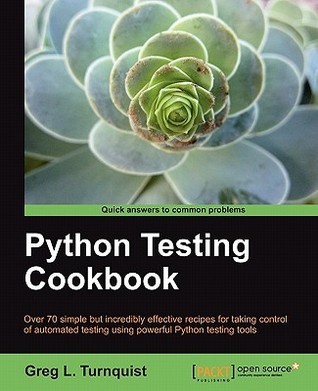
#464 Python Testing Cookbook
Book notes - Python Testing Cookbook, by Greg L. Turnquist. First published May 14, 2011.
Notes
The first edition of the book was written in the Python 2.6 era. A second edition was published in 2018 but I have not read it and it appears to have been abandoned by the author and publisher.
Contents
- Chapter 1: Using Unittest To Develop Basic Tests
- Introduction
- Asserting the basics
- Setting up and tearing down a test harness
- Running test cases from the command line with increased verbosity Running a subset of test case methods
- Chaining together a suite of tests
- Defining test suites inside the test module
- Retooling old test code to run inside unittest
- Breaking down obscure tests into simple ones
- Testing the edges
- Testing corner cases by iteration
- Chapter 2: Running Automated Test Suites with Nose
- Introduction
- Getting nosy with testing
- Embedding nose inside Python
- Writing a nose extension to pick tests based on regular expressions
- Writing a nose extension to generate a CSV report
- Writing a project-level script that lets you run different test suites
- Chapter 3: Creating Testable Documentation with doctest
- Introduction
- Documenting the basics
- Catching stack traces
- Running doctests from the command line
- Coding a test harness for doctest
- Filtering out test noise
- Printing out all your documentation including a status report
- Testing the edges
- Testing corner cases by iteration
- Getting nosy with doctest
- Updating the project-level script to run this chapter’s doctests
- Chapter 4: Testing Customer Stories with Behavior Driven Development
- Introduction
- Naming tests that sound like sentences and stories
- Testing separate doctest documents Writing a testable story with doctest Writing a testable novel with doctest Writing a testable story with Voidspace
- Mock and nose
- Writing a testable story with mockito and nose
- Writing a testable story with Lettuce
- Using Should DSL to write succinct assertions with Lettuce Updating the project-level script to run this chapter’s BDD tests
- Chapter 5: High Level Customer Scenarios with Acceptance Testing
- Introduction
- Installing Pyccuracy
- Testing the basics with Pyccuracy Using Pyccuracy to verify web app security
- Installing the Robot Framework
- Creating a data-driven test suite with Robot Writing a testable story with Robot
- Tagging Robot tests and running a subset
- Testing web basics with Robot Using Robot to verify web app security
- Creating a project-level script to verify this chapter’s acceptance tests
- Chapter 6: Integrating Automated Tests with Continuous Integration
- Introduction
- Generating a continuous integration report for Jenkins using NoseXUnit Configuring Jenkins to run Python tests upon commit
- Configuring Jenkins to run Python tests when scheduled Generating a CI report for TeamCity using teamcity-nose Configuring TeamCity to run Python tests upon commit
- Configuring TeamCity to run Python tests when scheduled
- Chapter 7: Measuring your Success with Test Coverage
- Introduction
- Building a network management application
- Installing and running coverage on your test suite
- Generating an HTML report using coverage
- Generating an XML report using coverage
- Getting nosy with coverage
- Filtering out test noise from coverage
- Letting Jenkins get nosy with coverage
- Updating the project-level script to provide coverage reports
- Chapter 8: Smoke/Load Testing-Testing Major Parts
- Introduction
- Defining a subset of test cases using import statements
- Leaving out integration tests
- Targeting end-to-end scenarios
- Targeting the test server Coding a data simulator
- Recording and playing back live data in real time
- Recording and playing back live data as fast as possible
- Automating your management demo
- Chapter 9: Good Test Habits for New and Legacy Systems
- Introduction
- Something is better than nothing
- Coverage isn’t everything
- Be willing to invest in test fixtures
- If you aren’t convinced on the value of testing, your team won’t be either
- Harvesting metrics
- Capturing a bug in an automated test Separating algorithms from concurrency
- Pause to refactor when test suite takes too long to run Cash in on your confidence
- Be willing to throw away an entire day of changes
- Instead of shooting for 100 percent coverage, try to have a steady growth Randomly breaking your app can lead to better code
Source Code - First Edition
See examples_v1.